From Content Creator to Career: The Skills You're Building Without Realizing It

In 2021 I applied for a job I had no formal training for. Community Manager at LIV. No degree in community management. No previous tech/startup experience. Just a content creator who made tutorials and hung out in their Discord.
I almost didn't apply because I felt like an imposter. "They're looking for someone with experience. I just make videos."
I got the job. Then got promoted to Product Marketing Manager. Then got hired to do contract work by the Gorilla Tag developers based on work I did as a content creator.
What I didn't realize at the time was I wasn't "just making videos." I was building a professional skillset that translated directly to industry jobs. I just didn't have the vocabulary to describe it yet.
Why Content Creators Undervalue Their Skills
You think you're "just streaming" or "just making YouTube videos." That sounds like a hobby, not a career skill.
But when you start creating content, you use these skills:
Video production. Scripting, filming, editing, thumbnail design. SEO (search engine optimization) and platform algorithm strategy. Community management and moderation. Brand representation and professional communication. User education and technical documentation. Market research - figuring out what content performs and what your audience needs. Cross-platform content strategy.
That's not "just making videos." That's a marketing department's worth of skills.
The problem is you don't realize these are professional skills because you learned them by doing, not in a classroom. And you assume "real jobs" require degrees or certifications you don't have.
So you keep calling yourself "just a content creator" while companies are actively looking for people with exactly the skills you've spent years developing.
My Path from Content Creator to Industry Jobs
I was active in LIV's Discord community. I made LIV-related tutorials on YouTube. I streamed showcasing mixed reality on LIV's official Twitch channel, showcasing how their software worked for other creators.
In 2021, LIV posted a job opening for Community Manager. I saw it and immediately felt intimidated. I had no "formal" training. No degree in community management. No previous CM job on my resume. Just a bunch of videos and Discord activity.
But I applied anyway. What the heck, right?
I was an easy hire.
Not because of a degree or certification, but because I already had product knowledge from using LIV as a creator. I understood the community because I was part of it. I knew what creators struggled with because I'd struggled with the same things. I could answer questions, troubleshoot problems, and explain features in ways that made sense to users - not because I'd studied community management theory, but because I'd been doing it for my own audience for years.
Later, I got promoted to Product Marketing Manager. Not because I suddenly went school for marketing, but because my content creation skills directly translated.
SEO knowledge from optimizing YouTube videos for search and discovery. Video production skills from years of creating content. On-camera presentation skills from talking head videos and streams. Platform understanding from managing my own cross-platform presence across YouTube, Twitch, TikTok, and Instagram.
(This video is version 2 of this tutorial and was posted in 2023!)
And a skill that ended up being really inportant? Translation. Understanding what developers wanted to communicate versus what creators would actually understand and care about. Developers think in technical specs and feature lists. Creators think in "what problem does this solve for me?"
I'd spent years translating technical VR concepts into beginner-friendly tutorials. That's literally what product marketing is - making complex products accessible to end users.
When I got laid off from LIV late 2025, Another Axiom (the Gorilla Tag developers) found one of my posts about it. They had an opening that needed filling ASAP and thought I'd be perfect.
They already knew me from my work at LIV. We'd partnered with the Gorilla Tag team to get LIV Creator Kit running in their game. A lot of my talking head videos on LIV's social accounts were filmed in Gorilla Tag, so they knew I had experience with the game and the camera tools. They'd seen the content I created - the scripting, the editing, the presentation style.
(Throwback to my first video ever on the LIV Tiktok as a monke 🥹)
I got the job because of skills I built as a content creator, not in spite of being a content creator.
I also got a writing gig (still ongoing!) at VR Wave from a cold email in late 2021. The CEO found my YouTube channel and asked if I wanted to write 2-3 articles about VR industry news and tutorials per month for their blog.
I said yes and discovered I actually love writing. It's so much faster than recording and editing video. And when done right, blog content helps with SEO for websites - which is something I already understood from optimizing YouTube content.
None of these opportunities required formal credentials. They required skills I'd built as a content creator. I just had to learn how to recognize those skills as professional experience instead of dismissing them as "just making videos."
The Skills You're Building Today
Here are the professional skills you're developing right now as a content creator, even if you don't think of them that way:
SEO and Discoverability
You're learning how search engines work. How titles, descriptions, and tags affect visibility. How to optimize for YouTube search versus Google search (and AI, but that’s a different blog post). How platforms prioritize content. Which keywords drive traffic. How thumbnails and titles work together to drive clicks.
That's literally what marketing teams pay people to do. SEO specialists, content strategists, growth marketers - these are six-figure jobs that require exactly the knowledge you're building by trying to get your videos discovered.
Professional Self-Representation
You're learning how to conduct yourself online. How to represent yourself (or a brand) professionally. How your words reflect not just on you, but on everyone associated with you.
When I posted on LIV's social accounts, I wasn't just representing myself anymore. I was representing the entire company and everyone employed by it. One careless tweet could reflect badly on the whole organization.
Content creators who manage their own brand presence already understand this instinctively. You know how to stay professional in public while still being authentic. You know how to handle criticism without getting defensive. You know when to engage and when to walk away.
Those are skills. Valuable ones.
Breaking Down Complex Topics for Beginners (Teaching Without Assuming Knowledge)
You're learning how to make complex things easy to understand. How to not assume everyone already knows certain parts and skip over them. How to remember what it was like to start at zero with no experience.
That beginner's mindset is what makes good tutorials. It's also what makes good employee onboarding, good documentation, and good user education.
When I made VR streaming tutorials, I had to remember what confused me when I started. Which steps felt obvious to me now but would trip up a beginner? Which technical terms needed defining? What could I skip and what needed detailed explanation?
Pedagogy is the skill of teaching effectively, and it's incredibly valuable in tech jobs where you're constantly onboarding new users or explaining features to non-technical audiences.
Community Management Fundamentals
Do you manage your own Discord community? Use and manage Discord bots? Create channels and roles? Moderate conversations? Handle conflict between members? Set and enforce community guidelines?
Those are community management skills. Companies hire people specifically to do that. Community managers at gaming companies, social platforms, and studios are doing exactly what you're already doing for your own audience.
The only difference is they have "Community Manager" in their job title and you don't. The actual work is very similar.
Video Production
Scripting. Filming. Editing. Thumbnail creation. Color grading. Audio mixing. Pacing. Transitions. Music selection. Export settings for different platforms.
You're learning the entire video production workflow. Not just one piece of it - the whole thing from concept to published video.
Social media managers, video editors, content strategists - these are all separate jobs at larger companies. You're doing all of them. You might not think of yourself as a "video producer" but that's exactly what you are.
Real Career Paths VR Content Creators Have Taken
You're not the only one building a career from content creation. Here are real examples from others the VR space who walked that path:
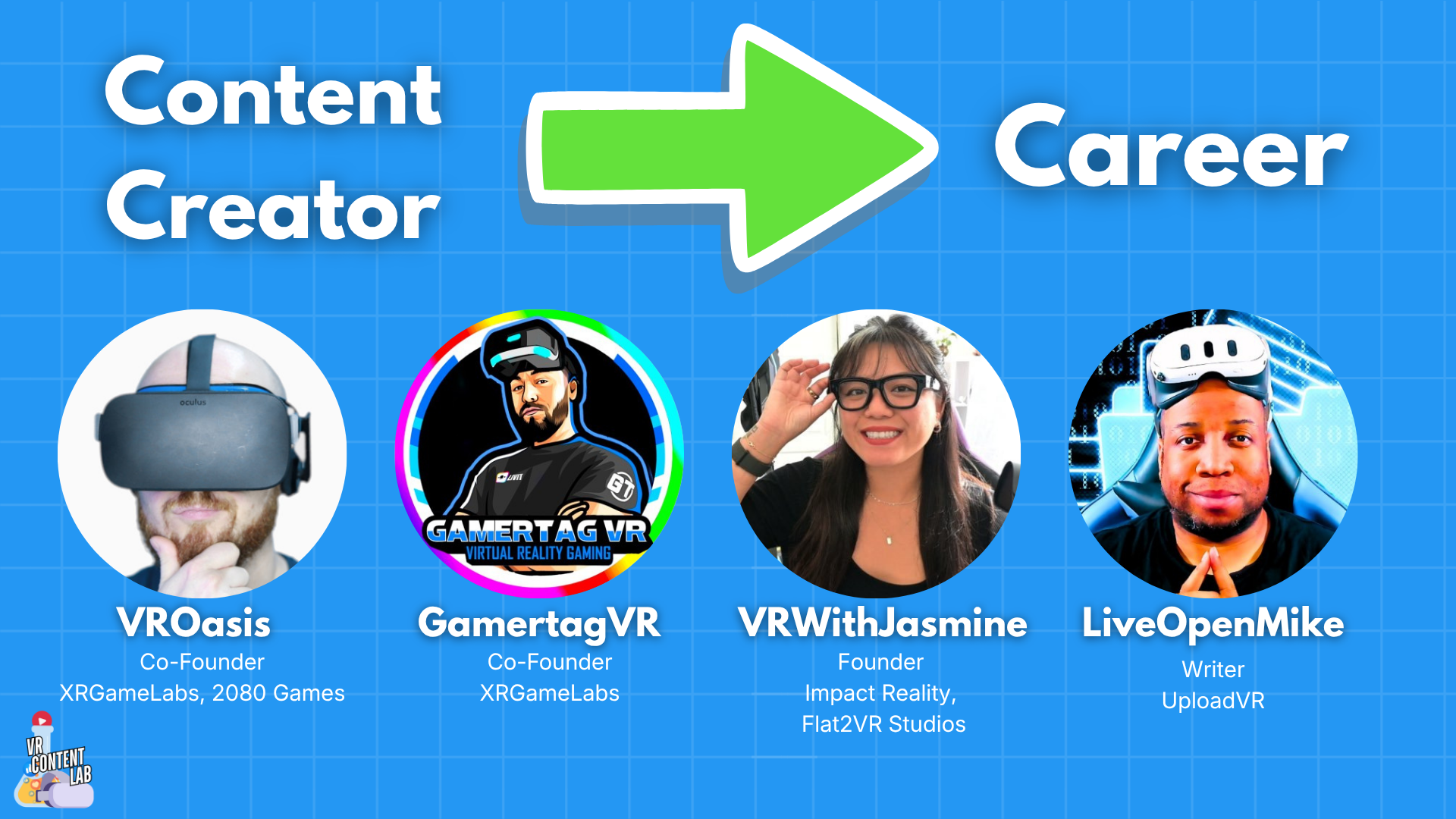
Mike (VROasis) became co-founder of or XRGameLabs and 2080 Games.
GamertagVR became co-founder of XRGameLabs.
VRWithJasmine founded Impact Reality, Impact Labs, and Flat 2 VR.
Multiple other creators were hired by Impact Reality/Labs/Flat2VR in various roles - production, community management, content strategy. (Including but not limited to - Eric Masher and Todd Jackson from Q2C VR Gamer, Skeeva from Between Realities, Damien from Ruff Talk VR, Myles from PSVR Without Parole)
LiveOpenMike became a writer for UploadVR.
ZStormVR and SoulBC went to work for Combat Waffle Studios (Ghosts of Tabor) in media and marketing, respectively.
And there are plenty of other examples out there! Content creation is a legitimate pathway into game development studios, media companies, hardware manufacturers, and VR startups. It's not just a side hobby waiting to become something "real." It is real. The skills are real. The career opportunities are real, should you choose to go in that direction.
How to Position Yourself When You Have "No Formal Experience"
When I applied for the LIV Community Manager job, I didn't have "Community Manager" on my resume. Here's what I did have:
Active participation in LIV's Discord - proof I understood the community and the product. LIV tutorials on YouTube - proof I could teach the product and troubleshoot problems. Streams on LIV's official Twitch channel - proof I could represent the brand professionally in real-time.
I framed my content creation experience as professional experience. Because it was.
For community management roles:
Instead of "I run a Discord server," say "Community platform administration with 100+ active members."
Instead of "I moderate comments," say "Content moderation and conflict resolution across multiple platforms."
Instead of "I answer DMs," say "Community support and user education, averaging 25+ user inquiries per week."
For marketing and social media roles:
Instead of "I grew my YouTube channel," say "SEO strategy and audience development, growing subscriber base from 0 to 8K in 3 years."
Instead of "I post on multiple platforms," say "Multi-platform content strategy across YouTube, Instagram, TikTok, and Twitter/X."
Instead of "I check my analytics," say "Performance analytics and content optimization using YouTube Studio, Instagram Insights, and Google Analytics."
For video production roles:
Your content portfolio IS your resume. Link to your channel, your best work, your range of content types. Highlight specific technical skills: Adobe Premiere, DaVinci Resolve, OBS, Photoshop, whatever tools you actually use.
Show variety. Tutorials demonstrate teaching ability. Talking head videos show on-camera presence. Edited montages show pacing and music selection. Thumbnails show design sense.
For writing roles:
Tutorials and how-to guides become "Technical documentation and user education."
Video scripts become "Content scripting and narrative structure."
Blog posts (if you have them) become "SEO-focused content writing with keyword research and optimization."
Even YouTube video descriptions and community posts count as writing samples if they're well-written and engaging.
You're not "just a content creator." You're a marketer, video producer, community manager, educator, and brand strategist who happens to create content.
Reframe your experience using professional language, and suddenly you're qualified for jobs you thought required degrees you don't have.
When to Make the Jump (And When Not To)

Make the jump when:
You're burned out on content creation and genuinely excited about the opportunity. Not just "this pays better" but "I actually want to do this work."
The job uses skills you're already good at and enjoy using. You're not forcing yourself into something you hate just because it sounds more legitimate than "content creator."
You have financial stability to take the risk. Industry jobs are steadier income than content creation, but they also mean giving up some creative freedom and flexibility.
The company and role align with your values and interests. I loved working at LIV because I already loved the product and the community. The job let me do what I was already doing, but with more resources and a team.
Don't make the jump when:
You're just frustrated with slow content growth. Jobs have frustrations too. Trading content creation problems for corporate problems doesn't automatically make life better.
You're hoping a "real job" will validate your work. It won't fix imposter syndrome. If you don't value your content creation skills now, having a job title won't magically make you feel legitimate.
You'd resent giving up creative control. Working for a company means your content serves their goals, not yours. If that sounds suffocating, stay independent.
The job doesn't actually interest you beyond "it pays better." Money alone isn't enough to sustain motivation. You'll burn out just as fast in a job you hate as you would creating content you're bored with.
I loved working at LIV because I already loved the product and the community. The job let me do what I was already doing - teaching creators how to use mixed reality tools - but with more resources and a bigger platform.
I love working with Another Axiom because I had great admiration for Gorilla Tag and its creators and had been creating content in through LIV. The work feels natural because it's an extension of what I was already passionate about.
If the opportunity doesn't align with what you're already passionate about, the paycheck won't make it worth it.
Truthfully, You Probably Can't Do Both Well
I do want to add an extra section here, something that hit me hard: working for a company means you have less time and energy to focus on your own personal content.
Some of the creators I mentioned earlier went from content creation to just their industry job. Full transition. No more personal channel(s).
Some still manage to do both, but it's harder. Way harder.

I'm trying to do both right now. Personal content creation on AtomBombBody. Contract work with Another Axiom. Marketing VR Content Lab as a course. It's a lot. It's stressful.
My focus has to shift depending on my current situation and priorities. Sometimes personal content takes a backseat because contract work pays the bills. Sometimes course marketing gets priority because I'm trying to grow that business. Sometimes I barely post on my personal channels for weeks because I'm underwater with other commitments.
That's okay. That's normal.
But it's something you need to know going in: taking an industry job isn't just adding to your schedule. It's trading some of your creative freedom and personal content time for steady income and professional structure.
For some people, that trade is worth it. They're relieved to have consistent paychecks and not worry about algorithm changes tanking their income. They like working on a team instead of doing everything solo.
For other people, it's suffocating. They miss the creative control. They resent having their content serve someone else's goals. They realize the stability isn't worth losing the thing that made them excited about creating in the first place.
Neither path is wrong. But you need to know the tradeoff exists before you make the jump.
Understanding how content creation builds transferable professional skills and how to navigate the tension between industry work and personal content is part of the long-term creator strategy we teach in Module 5 of VR Content Lab. How to build a sustainable career whether that means staying independent, transitioning to industry jobs, or creating hybrid opportunities that combine both.
You're not "just a content creator." You're a professional with a portfolio of real-world experience that companies are actively looking for.
The only thing standing between you and those opportunities is recognizing the value of what you've already built. And understanding what you might be giving up if you take them.
VR Content Lab teaches creators how to navigate these decisions strategically—not just "should I take this job?" but "what does this mean for my long-term goals?" It's a self-paced video course with a Discord community where you can connect with other VR content creators navigating career decisions, building professional skills, and creating sustainable opportunities in the VR industry.
Check it out and enroll at vrcontentlab.com.
