Stop Scrolling, Start Creating

Sound familiar? You sit down to edit. Open Capcut. Stare at the timeline. Your brain feels foggy. You can't focus. Nothing feels right, so you check TikTok. Juuust a quick scroll to “get inspired." 30 minutes later, you're still scrolling, and your editing time is gone. This is due to something called “attention residue”.
Note: This post references Deep Work by Cal Newport. Links to the book are affiliate links I earn a small commission if you buy through them, at no extra cost to you.
What Attention Residue Actually Is
The term comes from business professor Sophie Leroy's 2009 research, later popularized by Cal Newport in his book Deep Work. (Great book btw, highly recommend)
When you switch tasks, part of your brain stays stuck on the previous task. That's attention residue.
You close TikTok and open Capcut, but your brain is still processing those 20 videos you just watched. The fast cuts, music, and the dopamine hits every 8 seconds.
Now you're trying to do deep work (editing) with a brain trained for shallow work (scrolling).
It doesn't work. Your focus is split between what you're trying to do and what you just did.
Leroy's research found it takes 15-25 minutes to fully recover focus after switching tasks. You never get 25 uninterrupted minutes, so you never actually focus.
The Research Behind It
In one of Leroy's experiments, participants started by working on word puzzles. Midway through, they were interrupted and asked to make hiring decisions for a candidate. Then they were tested on how well they could identify whether flashed letters on a screen formed real or fake words.
The results? Participants with more attention residue from the word puzzles performed significantly worse on the letter recognition task. The stronger the residue, the worse they performed.
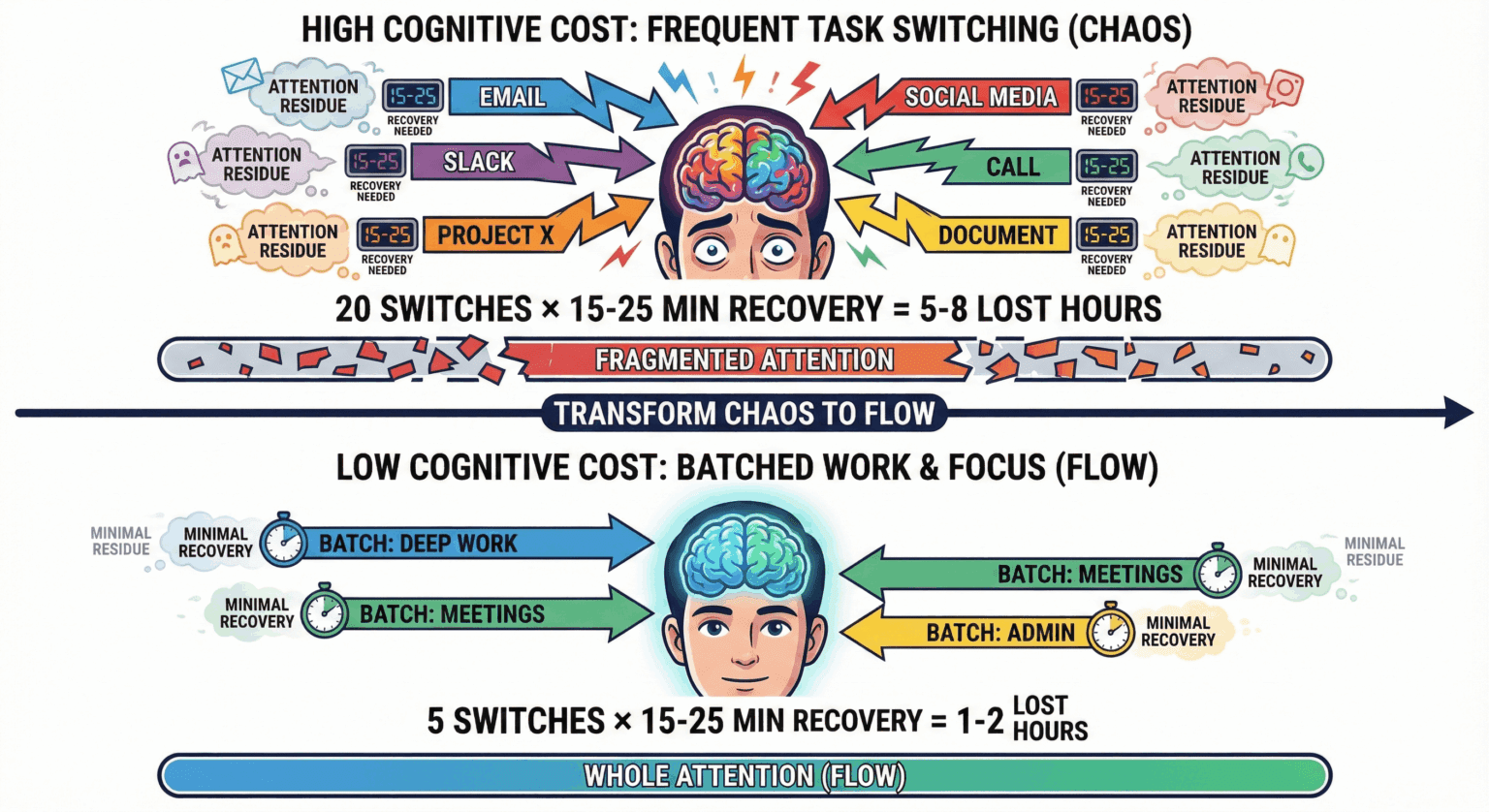
Credit: https://timeblockingtool.com/
In a later study with researcher Theresa Glomb, Leroy found something even more revealing: participants who expected time pressure when returning to an interrupted task showed both high levels of attention residue and worse performance on the interrupting task.
Your brain doesn't want to let go of unfinished work. It keeps it active in the background, which means fewer cognitive resources for whatever you're trying to do now.
Why This Kills Your Content Quality
Editing requires deep focus. You're making small decisions constantly:
Which clip flows better here?
Does this cut feel right?
Is the pacing dragging?
Does the music match the energy?
Those decisions require focus. Not “sort of paying attention while half your brain is still on TikTok" focus. Real focus.
When you're operating on attention residue, your editing gets sloppy. You miss obvious mistakes because your brain isn't fully present.
Then you wonder why your videos aren't as good as you want them to be. It's not a skill issue, it's focus issue!
Consumption-to-Creation
Being a content creator requires both consuming content (research, staying current, seeing what works) and creating content (filming, editing, writing).
But those modes are opposites.
Consumption mode: passive, reactive, fast-paced, dopamine-driven, shallow focus.
Creation mode: active, intentional, slow-paced, delayed gratification, deep focus.
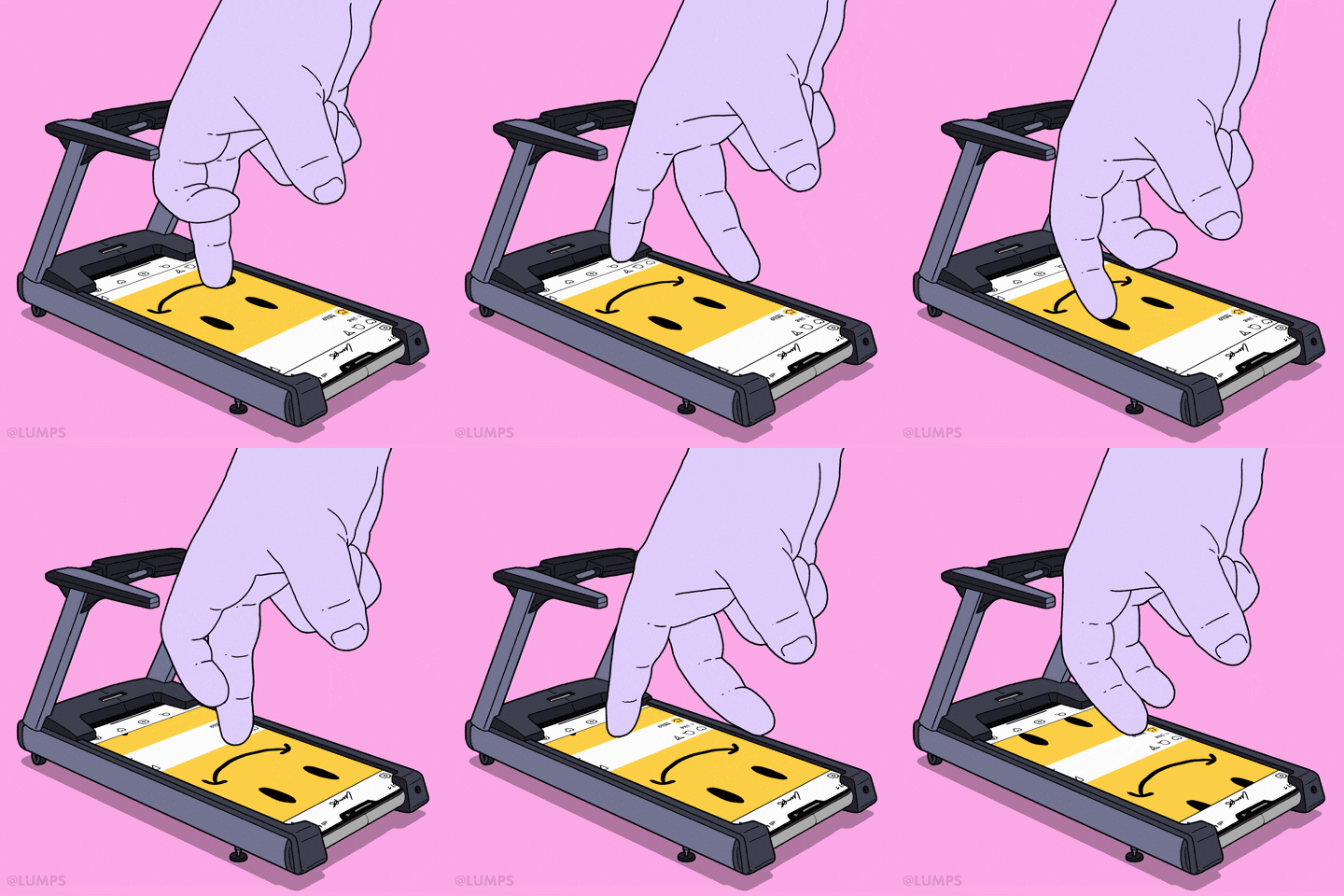
You can't do both at once, and switching between them has massive attention residue costs.
I've tested this. Days where I scroll TikTok or YouTube Shorts before or while editing my editing sessions take 2x as long and the quality is worse. Days where scroll first, then edit after I have faster sessions and better output.
Methods to Combat This
Time-Block Your Consumption and Creation
Don't mix them!
An example schedule:
Morning: Consumption (research, scrolling, checking comments). I do this in the AM first thing while I walk my cat in the backyard (yes, you heard that right).
Afternoon/evening: Creation (editing, filming, writing). Brain is fresh, no attention residue.
Put Your Phone in Another Room
Not on silent, not face-down. Another room.
If it's next to you, you'll check it every time the screen flashes or you hear a notification sound. Even if you don't unlock it, the temptation creates attention residue.
90-Minute Editing Blocks
Zero interruptions. No Discord. No comments. No “just checking." Nothing.
Set a timer. Edit until it goes off. Then take a break. If you can't do 90 minutes at first, start with 30 minutes and build up from there.
Airplane Mode or App Blockers
Freedom, Cold Turkey, whatever works. Block social media during creation time.
“But I need to stay active on social!" Sure, just not during editing. Post after, engage after, create first.
The 15-Minute Rule
After scrolling or checking notifications, wait 15 minutes before starting creative work. Let the attention residue clear.
Walk around. Make coffee. Stretch. Give your brain time to switch modes.
Remember: Leroy's research shows it takes 15-25 minutes to fully recover focus. That 15-minute buffer isn't wasted time, it's necessary recovery time.
I'm Bad at This Too
I'll be the first to admit that I'm bad at this. I check my phone constantly. I scroll between tasks. I know better and I still do it.
But the days when I actually set the time to focus, the difference is massive. I get more done in 90 focused minutes than 4 hours of distracted "editing."
Balancing working on Gorilla Tag socials, VR Content Lab marketing, and personal content means I need every minute of focus I can get. Can't afford to waste 2 hours on attention residue.
You don't need more time, you need better focus.
The hard part isn't knowing what to do. It's actually doing it when your brain is screaming for another dopamine hit from scrolling.
This Is Getting Worse
Platforms are designed to keep you scrolling. TikTok, Instagram Reels, YouTube Shorts, the algorithms are all tweaked for maximum engagement, which means maximum distraction for you.
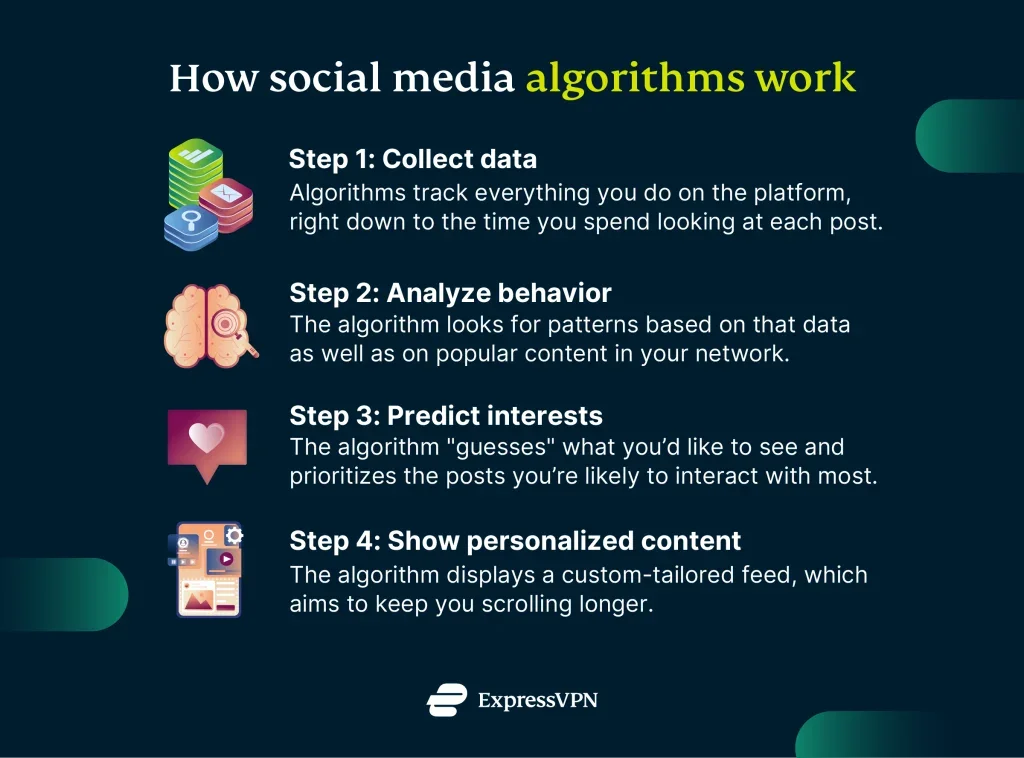
Image credit: ExpressVPN
Every scroll gives you a tiny dopamine hit. Your brain gets trained to expect constant stimulation. Then you sit down to edit, which requires sustained focus on one thing for an extended period, and your brain rebels.
“This is boring. Check your phone. See if anyone commented. Just one quick look." That's your brain doing exactly what it's been trained to do. Its basically an addiction to tiny dopamine hits throughout the day.
Breaking that training takes deliberate effort. You have to actively fight against platforms designed by teams of engineers whose entire job is keeping you engaged.
Start Small
Don't try to go from constant scrolling to 90-minute deep work sessions overnight.
Week 1: Phone in another room during one editing session. Just one.
Week 2: Two sessions with no phone.
Week 3: Try 30-minute focused blocks before checking anything.
Week 4: Build up to 60 minutes.
You're retraining your brain! That takes time.
Put your phone in another room. Edit for 30 minutes uninterrupted. See what happens.
That's the most practical advice in this entire post. Everything else is context for why that one thing works.
Understanding how to protect your focus and build sustainable creator habits is part of what we teach in Module 5 of VR Content Lab - not just what to create, but how to actually create it without burning out or getting distracted. The course will be on sale for $37 (normally $57) from May 21-25 if you want to grab it then!
Check it out at vrcontentlab.com.
